
Marketing Agency AI Dialer That Scales Campaigns
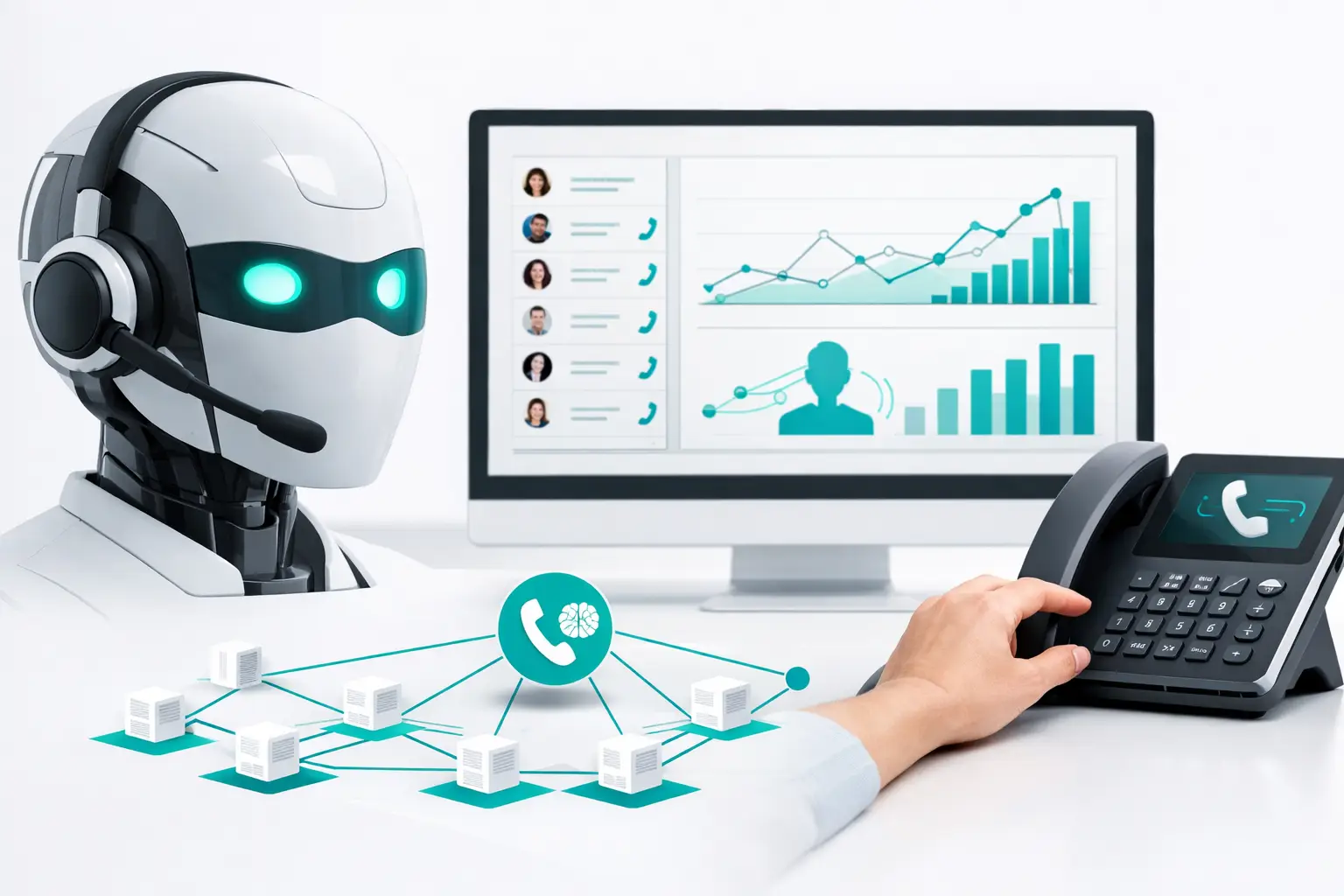
A marketing agency AI dialer should not be treated as a faster way to place calls. For an agency running client campaigns, it is an operating layer that determines whether leads receive timely follow-up, whether booked appointments reach the right calendar, and whether performance can be proved without stitching together five dashboards.
That distinction matters when your agency manages multiple client accounts, campaigns, lead sources, and sales workflows. A basic dialer can increase call volume. It cannot, by itself, reconcile lead status changes in the CRM, route qualified conversations to the proper team, manage number health, or show which source produced appointments rather than just answered calls.
Why agencies outgrow standalone dialers
A standalone dialer usually solves one narrow problem: initiating calls from a list. That works for a small internal sales team with one pipeline and one calling motion. Agencies operate under different conditions. They need to launch campaigns for separate clients, use different scripts and qualification criteria, honor distinct business hours, and report results at the account level.
The operational failure point is rarely the AI voice agent itself. Most agencies can connect an agent to a phone number and make a call quickly. The hard part starts afterward: determining what happens when a prospect asks for a human, when an appointment needs to be created, when a lead does not answer, or when the CRM has conflicting data.
Without a coordinating layer, teams build these steps through one-off automations. A webhook updates one system. A separate automation sends a text message. An account manager manually checks another dashboard for outcomes. That setup can work for a pilot, but it becomes fragile when an agency adds clients, channels, or call volume.
What a marketing agency AI dialer needs to run production campaigns
The right system is less about a single dial mode and more about campaign control. Agencies need to configure the workflow around the conversation, not force every client into the same calling template.
Lead intake and CRM synchronization
Leads may enter from paid media forms, a client CRM, a booking tool, a lead marketplace, or an enrichment platform. The dialer needs a reliable way to receive those records, identify the client and campaign, apply the appropriate workflow, and write outcomes back to the system of record.
Bidirectional CRM sync is not a convenience feature. It prevents the common scenario where the AI agent qualifies a prospect, but the sales team continues working an old lead status because the result never reached the CRM. For agencies using HubSpot, Salesforce, GoHighLevel, or a client-specific CRM, record ownership and field mapping should be defined before calls begin.
A useful setup also handles duplicates, suppression rules, time-zone fields, and lifecycle stages consistently. If those controls are missing, more automation simply creates more bad handoffs.
Dialing logic that matches lead intent
Not every list deserves the same cadence. A newly submitted form may require an immediate progressive call attempt, while an older re-engagement segment may fit a more measured sequence. Campaigns should define when calls occur, what happens after an unanswered attempt, and when a lead moves to a different channel.
Predictive dialing can be useful for higher-volume programs with available human capacity for transfers. Progressive dialing is often better when the agency needs tighter pacing, more controlled routing, or a specific AI-to-human handoff process. Neither mode is universally better. The correct choice depends on lead volume, answer rates, sales-team availability, and the client’s qualification workflow.
The important point is that dialing logic cannot be isolated from routing. An AI agent that generates qualified transfers faster than the client can answer them creates a poor prospect experience and a misleading campaign report.
AI agent orchestration and human handoff
Agencies increasingly bring their own voice agent provider, whether that is Vapi, Retell, or a custom agent stack. The dialer infrastructure should not require replacing that investment. It should provide the operational framework around the agent: numbers, carriers, campaign rules, routing, CRM updates, reporting, and fallbacks.
Human handoff needs explicit rules. A qualified call might transfer to a client sales rep, a shared agency closer, a dedicated call center queue, or a booking workflow. Each path should have a defined fallback if no one answers. That may mean a callback task, a scheduled appointment, or a follow-up sequence based on the conversation outcome.
This is where agencies protect client results. A strong AI conversation is wasted if the next step is an unanswered transfer to an unprepared team.
Multi-channel follow-up without fragmented records
Phone is often the highest-intent channel, but it is not the only channel that matters. A call outcome may trigger a compliant follow-up through SMS, email, WhatsApp, webchat, or social direct messages, depending on the campaign and the permissions available. The agency needs one conversation record rather than disconnected activity logs.
For example, a solar lead who does not connect by phone may receive an approved follow-up message, then return through webchat later that day. If the original lead source, call disposition, and new interaction live in separate systems, attribution becomes unreliable. If they are connected, the agency can see the full path from lead capture to appointment.
Reporting should answer client questions, not platform questions
Clients do not buy call attempts. They buy booked appointments, qualified opportunities, recovered leads, and revenue contribution. Agency reporting should be built backward from those outcomes.
At minimum, each campaign should make it possible to inspect lead volume, connection rate, conversation outcomes, transfers, appointments, disqualifications, and follow-up completion. Those numbers need to be segmented by client, source, campaign, time period, and agent configuration where relevant.
The deeper value comes from connecting operational metrics to bottlenecks. A low appointment rate may be a lead-quality issue, a calling-window problem, an agent prompt issue, or a weak transfer process. A dashboard that only shows total calls cannot distinguish among them.
Call recordings, transcripts, and disposition data should support a regular quality review process. Agency operators can identify recurring objections, incomplete qualification steps, dead-end transfer paths, and inconsistencies between campaigns. That is how AI calling becomes an optimization program rather than a black-box service line.
Build the infrastructure before scaling volume
Many agencies start with the prompt because it is visible and easy to adjust. Start with the operational design instead. Define campaign ownership, CRM fields, routing destinations, business-hour rules, outcome taxonomy, escalation paths, and reporting requirements. Then configure the agent around that framework.
A production-ready rollout should answer four practical questions:
- Where does every lead enter, and which system owns the record?
- What exact outcome should trigger a transfer, booking action, follow-up, or stop condition?
- Who receives a qualified conversation, and what happens if that person is unavailable?
- How will the agency prove performance by client, campaign, and lead source?
VoiceUni is built for this layer of work. It lets agencies keep their AI agent, carrier, numbers, CRM, and data sources while coordinating calling operations and follow-up workflows across eight channels. That avoids the usual trade-off between a flexible AI stack and a manageable client operation.
The agency advantage is operational discipline
An AI dialer can help an agency respond to leads faster and expand coverage without adding the same amount of manual calling labor. But scale alone is not the advantage. The advantage is running a repeatable system that preserves context from lead capture through conversion, gives clients clear evidence of performance, and does not collapse under the weight of another account.
Build the campaign workflow as carefully as the call script. When routing, CRM data, handoff rules, and reporting are connected, the AI dialer stops being a feature you demo and becomes an operating capability your clients can depend on.
More from the VoiceUni Blog.

What Drives Solar Appointment Booking Results
A solar operator booking 150-plus appointments in a single week is not winning because it found a magic script. It is winning because its lead response, qualification, routing, follow-up, and reporting are operating as one system. Solar appointment booking results are usually decided in the handoffs between those st...

AI Phone Number Reputation Guide for Call Teams
A campaign can have clean data, a capable AI voice agent, and a well-built follow-up sequence, yet still underperform for one basic reason: the originating phone number has lost trust. This AI phone number reputation guide is for operators who need to protect answer rates before poor number health turns into a pipel...

AI Contact Center Software Review for Operators
An AI contact center software review should start where most evaluations fail: the live workflow, not the demo. A voice agent that can hold a convincing conversation is only one component. Revenue operations still need the right lead data, approved contact rules, routing logic, carrier capacity, CRM updates, human e...
Get new posts by email.
One email a month, no spam, unsubscribe anytime.