
Solar AI Booking Case Study: 150+ in a Week
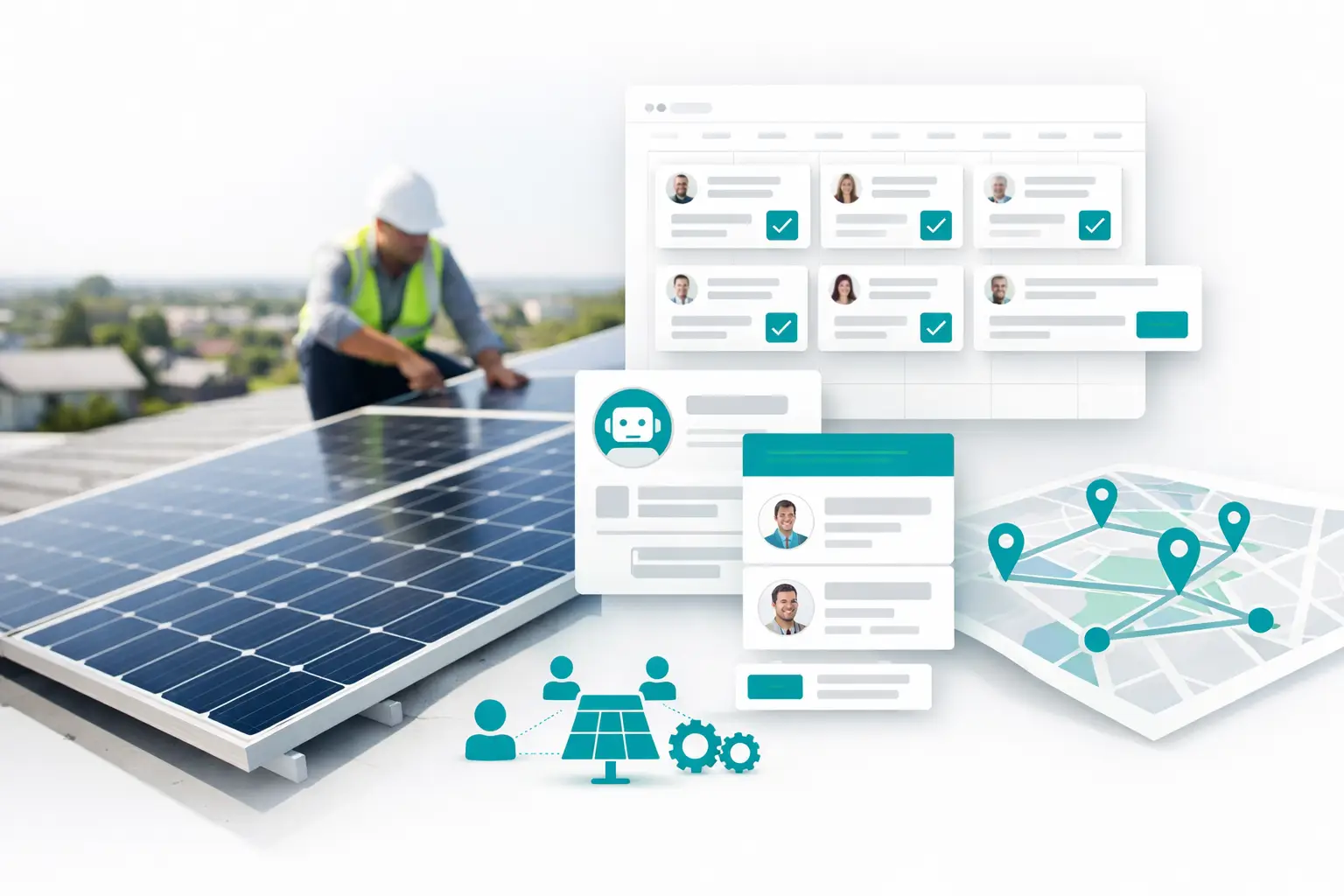
Most solar teams do not have a lead problem. They have a contact problem. Leads come in from paid search, forms, speed-to-lead vendors, aging database campaigns, and referral partners. Then the real failure starts - slow response times, disconnected tools, missed callbacks, agent no-shows, and no clean view of what actually booked. This solar AI booking case study is about fixing that operational layer, not just adding another AI agent.
The operator in this case was already investing in demand generation. Volume was there. What they lacked was a reliable system to turn inbound and outbound conversations into confirmed appointments at scale. Their stack looked familiar: telephony on one side, CRM on another, lead sources feeding in unevenly, and an AI voice layer that could talk but could not fully orchestrate routing, retries, handoffs, and reporting across the workflow.
Solar AI booking case study: the actual bottleneck
At a glance, the problem looked simple. Book more appointments from existing lead flow. In practice, the issue was structural.
New leads were not being worked consistently across channels. Inbound callers hit different paths depending on source and time of day. Outbound follow-up lived in fragmented campaigns with limited visibility into contact attempts, outcomes, and booking quality. Human reps were filling gaps manually, which meant performance depended on who happened to catch the lead first.
That setup can produce isolated wins, but it does not hold up under volume. In solar, timing matters. If a homeowner requests a quote and waits 20 minutes for a callback, conversion drops. If an AI agent reaches them quickly but cannot route to the right market, reschedule correctly, or sync cleanly into the CRM, the booked appointment either never happens or creates downstream cleanup work.
The lesson is straightforward: AI voice can increase conversation volume, but booking performance depends on the infrastructure around it.
What changed in this solar AI booking case study
The operator deployed an orchestration layer between its AI voice provider, carrier setup, CRM, lead inputs, and scheduling workflow. That changed the role of the AI agent from a single conversation endpoint into part of a real operating system.
Inbound and outbound flows were unified. Leads from multiple sources entered standardized campaigns instead of ad hoc follow-up paths. The AI handled first-touch outreach and qualification, while routing logic determined what happened next based on disposition, campaign rules, business hours, geography, and escalation conditions.
This matters more than most teams expect. Booking is not one event. It is a chain: lead enters, contact attempt happens, conversation reaches the right script, qualification is captured, appointment is placed into the right calendar, confirmation is sent, and the CRM reflects the result. If any one of those breaks, revenue leakage starts.
In this case, the operator focused on four changes.
First, speed-to-lead became automated instead of rep-dependent. New inquiries triggered immediate outreach without waiting for a sales queue to clear.
Second, follow-up sequences became structured. If the first attempt failed, the system continued across approved touchpoints using predefined timing and logic rather than relying on one-off manual retries.
Third, routing became operationally aware. Calls were not just answered. They were directed based on campaign, region, availability, and handoff conditions.
Fourth, reporting became usable. The team could see not only call volume, but lead status progression, booking outcomes, and where fallout occurred.
The result: 150+ appointments in one week
The headline result was 150+ appointments booked in a single week for the solar operator. That number is useful, but only if you understand why it happened.
It was not because the AI suddenly became persuasive in a vacuum. It happened because the system reduced friction at every stage between lead creation and confirmed booking. More leads were contacted fast. More conversations reached the correct workflow. Fewer handoffs failed. Less data disappeared between tools. Managers could see performance in time to make changes while campaigns were still running.
That is the difference between a demo-worthy AI workflow and a production workflow. One sounds good in a call recording. The other survives real campaign conditions.
There is also an important trade-off here. Increasing contact rates can expose weaknesses elsewhere. If scheduling logic is messy, calendars are misconfigured, or CRM ownership rules are unclear, more conversations can create more chaos. The operator in this case avoided that by treating booking as an operations problem, not only a conversational AI problem.
Why solar teams struggle with AI booking
Solar is a strong fit for AI-assisted booking, but it is also a vertical where weak infrastructure gets exposed quickly. Lead sources are varied. Response windows are tight. Territory coverage matters. Qualification criteria can change by market, financing model, utility zone, or install constraints. You need more than a voice bot that can ask a few questions.
You need a system that can enforce logic consistently.
For example, some operators need different treatment for fresh inbound leads versus aged records. Some need immediate transfer to a live setter during business hours and automated scheduling after hours. Others need channel switching when a call is missed or voicemail is detected. Those are not edge cases. They are normal operating conditions.
A lot of teams try to solve this by stacking point solutions. One vendor for voice. One for SMS. One for CRM sync. One for call routing. One for analytics. It works until one webhook fails, one carrier issue hits answer rates, or one campaign change requires custom development. Then every result becomes hard to trust.
What this case study shows about infrastructure
The core takeaway from this solar AI booking case study is that orchestration is the multiplier.
An AI agent can speak, qualify, and book. But without the surrounding framework, it cannot manage campaign logic, failover, reporting continuity, channel coordination, and handoff discipline in a way serious operators need. That is where infrastructure decides whether your team gets a spike in activity or a repeatable appointment engine.
This is also why bring-your-own-stack matters. Many operators already have an AI provider they like, a CRM they are committed to, and existing numbers they do not want to replace. Rebuilding the stack just to test AI booking introduces risk and delays. A better model is to keep the components that work and centralize the operational layer between them.
That was the practical advantage in this deployment. The operator did not need a long engineering project to connect systems manually. The booking workflow was implemented as an integrated operation rather than a custom patchwork.
How to evaluate your own solar AI booking setup
If your team is trying to improve appointment volume, start by auditing the workflow instead of only the script.
Look at how fast new leads are contacted, how many attempts happen after the first miss, where calls route during and after business hours, whether AI and human handoff rules are explicit, and whether CRM records reflect real outcomes without manual cleanup. If you cannot answer those questions with confidence, the issue is likely operational visibility as much as AI performance.
It also helps to separate contact metrics from booking metrics. High answer rates do not guarantee qualified appointments. Likewise, a strong booking script cannot compensate for bad calendar logic or broken source attribution. Mature teams track the full progression from lead ingress to appointment held.
For some operators, the next step is tighter inbound handling. For others, it is structured follow-up across multiple touchpoints. For others, it is reducing the fragility of a stack held together by custom connections. It depends on where conversion is actually leaking.
One platform built for this kind of operational layer is VoiceUni, which sits between AI voice providers, carriers, CRMs, and channel workflows so solar teams can run production campaigns without maintaining brittle integrations.
The useful question is not whether AI can book solar appointments. It can. The better question is whether your current system can support AI booking under real campaign conditions, with routing discipline, reporting clarity, and enough control to scale what works. That is where the biggest gains usually are, and where the next 150 appointments tend to come from.
More from the VoiceUni Blog.

What Drives Solar Appointment Booking Results
A solar operator booking 150-plus appointments in a single week is not winning because it found a magic script. It is winning because its lead response, qualification, routing, follow-up, and reporting are operating as one system. Solar appointment booking results are usually decided in the handoffs between those st...

AI Phone Number Reputation Guide for Call Teams
A campaign can have clean data, a capable AI voice agent, and a well-built follow-up sequence, yet still underperform for one basic reason: the originating phone number has lost trust. This AI phone number reputation guide is for operators who need to protect answer rates before poor number health turns into a pipel...

AI Contact Center Software Review for Operators
An AI contact center software review should start where most evaluations fail: the live workflow, not the demo. A voice agent that can hold a convincing conversation is only one component. Revenue operations still need the right lead data, approved contact rules, routing logic, carrier capacity, CRM updates, human e...
Get new posts by email.
One email a month, no spam, unsubscribe anytime.